Aug 7, 2013

Astrology: A rational introduction

Astrology can be defined as “Logical interpretation of movements and relative positions of certain astronomical bodies with a belief that they have an influence on human affairs.”

When it comes to Astrology, entire population on earth fall into two groups; the first group is the ones who do not believe in astrology, while the second group is those who believe in astrology with a question, “People have been believing it for several millennia. How can they all be wrong?”.

True. There are evidence pointing out that kings had referred to astrology to predict the outcome of a war or natural calamities such as flood and drought. Astro bodies at certain positions were considered as a positive omen to start a public project such as building bridges, dams or temples and sometimes, even for the journey of a pilgrimage.

Does the position of certain astronomical bodies such as sun, moon, and planets really have an effect in predicting human behavior? Maybe, maybe not. But that is not what I'm going to write about in this blog post. Rather, I am going to focus on understanding the rationale behind astrology, scientific arguments which have made many generations believe in this field.

Let me first introduce you to the framework of a horoscope. The following picture shows a typical Tamil horoscope (also known as Jathagam). The building blocks of such a horoscope are the twelve boxes, popularly known as houses.
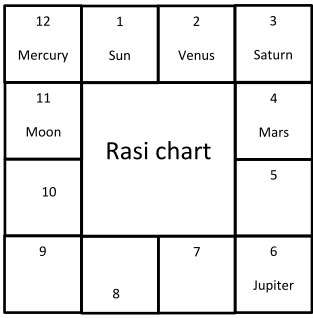
Typical horoscope showing the position of major planets

Before explaining the significance of twelve, let us first look into one of the most profound mathematical concept; 360 degrees. Many things that happen around us can be explained using 360 degrees. For example, earth completes 360 degrees when it revolves around itself once. It completes 360 degrees when it completes one full rotation (orbit) around the sun. Similar to Earth, other planets also complete 360 degrees for one full revolution about itself or one full orbit around the sun. Moon completes 360 degrees to orbit around the earth.

How can we perceive this 360 degrees movement of various astronomical bodies based on observations from a naked eye? There are several ways to do it. One simple way is to divide 360 degrees into 360 1-degree sectors and keep track of the planets when the move from one sector to another. However, certain planets such as Jupiter are farther away from the sun that it is extremely difficult to keep track of their 1-degree movement using naked eye.

We need to divide 360 into larger sectors to make the objects traceable. How large? Let us say, 4 sectors of 90 degrees each? The problem with such a fewer number of segments is that it becomes impossible to track the faster movement of planets that are closer to the sun, such as Mercury. So just like one would conduct a grid independence study, based on the experience people have found that having 12 sectors of 30 degrees each will make this problem tractable. But, on what rational basis did they arrive at twelve?

A long time ago, when there were no telescopes and technological gadgets around, people relied on naked eye observations. With no city lights to pollute, clear sky nights were absolutely dark that they were able to see far more stellar objects that are possible to see today only with the help of powerful telescopes.

One disadvantage of such a dark and starry sky is that it is extremely difficult to keep track of the movement of one particular object over a period of time. Solution? They started looking at the star's background to find its relative position with respect to other stars in its vicinity. In order to remember the position of various stars in the surrounding of the planet under observation, they identified some of the bright stars which do not move (on a relative scale) with respect to the planet. To make the problem easier, they grouped some of those bright stars to form a shape that is easy to remember. In other words, they formed a constellation.

They identified twelve major constellations with the help of twenty seven brightest and easily recognizable stars. The twelve constellations were roughly 30 degrees apart. So the problem of tracing a planet is now reduced to identifying in what background (constellation) does the planet lies at a specified time.

We would love to give names to anything right? Of course, we give names not only to the newborn but also to pets and things around. So it's not a wonder that people named those constellations (houses) based on their patterns such as Aries (Mesha), Taurus (Vrishabha) etc.

Now, all that one needs to do is to find in which house (constellation) does each of the observable planets reside at the time of their birth. In the typical example shown in the picture above, one can see that when viewed from the Earth (that's the reason why you won't find Earth in any of the houses), Mercury would set before sun while Venus sets right after sunset, followed by the Moon. When the sun and moon are in the same house, it is no moon day (or Amavasya) and when the sun and the moon are 180 degrees apart (or 6 houses apart), it is full moon day (or Purnima).

In terms of time, Earth takes 24 hours to complete one full revolution around itself (360 degrees). In other words, it takes 2 hours to rotate by 30 degrees. Since sunrise and sunset is defined with respect to Earth's rotation, the setting time of Mercury (Venus) would not be more than 2 hours before (after) sunset. However, using the same chart, it is possible to fix our frame of reference for time on some other planet as well.

For example, Jupiter takes 11.86 Earth years (4332 Earth days) to complete one orbit around the Sun (360 degrees). Hence, in order that Jupiter moves its position from one house to another (Transit of Jupiter), it will take 361 days (~ 1 Earth year).

Now the main question still remains. Does the location of planets in an arbitrary background at the time of one's birth have any significance in predicting their future? I will leave it up to the readers to find an answer to this question!

Aug 4, 2013

Novice Academician


While having a conversation with my wife, she asked me question, "Who inspired you to blog?"

The question sets my train of thoughts in motion. I looked back in to my glorious but forgotten past. It was in 2007 when I first ventured into blogging.

Back then, I was working as a SRF and have been following a few blogs that were published by professors on science and engineering topics. At some point, I believe, reading their articles inspired me to write!

I started a blog and named it after condensed form of my name, sramanujam. It was a wordpress blog. Soon, I changed the name of my blog to Novice Academician, though the domain name remain unchanged.

But I wasn't really an academician then! So I had set my blog's tagline as "not yet; will soon be".

Novice Academician published articles mostly on math, news, heat transfer and other sundries. One of my articles I wrote on conduction, convection and radiation got mentioned in a blog carnival.

"Well, I'm not sure who inspired me to blog. But I started blogging way back in 2007", I replied to my wife.

After a desperate search, I found that waybackmachine has archived my first blog that I had deleted about five years ago! Going through some of the articles that I had published in my earlier blog, my wife asked me, "Why did you delete it?"

Honestly, I don't know! Back then, I never thought that deleting a (first) blog is like orphaning it. But now, I feel very bad for what I did. The only thing that consoles me is the fact that there is a website that archives every website published in the world of internet. In fact, of all the websites I had ever browsed, I now rank web.archive.org higher than highest!

Jun 26, 2013

I thought, I wrote.

People often make mistakes. Often times, they get punished either by the court of law or by divine intervention. The punishments are mild, medium or hard based on their mistakes. But, there is a worse punishment one can ever subject to, punishing someone without giving him a proper reason. It's not just worse, it's inhumane.

People often get angry because they expect the world to move around them. But unfortunately, the world moves on its own path. We are not at the center of everything. We fail, we lose hope, we get frustrated because of this. Everyone has expectations, dreams, aspirations to be someone, to do something or to achieve something in their life. There is no single human on earth ever born who is happy because his expectations are fulfilled, dreams realized, aspirations achieved. Even M.K.Gandhi had dreams which are not fulfilled even today!

True, we cannot make the world move around us. But as a human being, we can only hope that at some point in our life, we can make the world stop and have a look at us. We can strive to get the world's attention for a moment on us. Unfortunately, for most people, this moment happens when they are no more. The world stops and thinks about that person when he/she is not alive to celebrate the moment with consciousness.

Only a few succeed in grasping this reality. Those who understood this are the ones who never hesitates to struggle in their life. They remain cool and composed because they know that things can't go wrong unless they try to manipulate and make the world move around them. They do have expectations, dreams, and aspirations. But their dreams are big. Bigger than us lesser mortals can comprehend.

Everyone is born, everyone would die one day. But there are very few who has the courage to struggle, who aspires to make the world pause for a moment and think about them when they are alive. It takes one spur of a moment for nature to take back the life it gave us. No one was born with a guarantee that he/she will stay alive till their dreams are fulfilled. But so long as we are alive, we have a choice; to leave our footprints in sands of time, or be forgotten. It is up to us to choose.

Jun 15, 2013

That moment!

"My water broke. Call the hospital", my wife cried in excitement.

"Sure I will!", I replied dialing the hospital number, checking the calendar meanwhile. "Saturday, May 25", it said.

I had a hunch that our baby will be born on 25th. After all, my wife and myself were both born on 25th! Won't it be awesome if our baby were to be born on the same day as ours?

"Her water broke at 5 AM. No, she did not have any contractions yet. No, we do not need an ambulance", I answered the protocol questions from the nurse-on-call. Jaisri woke her mom up while I called our friend Rachel who had offered us a ride to the hospital. "I will be there in ten minutes", she said over the phone. 

Meanwhile, Jaisri checked the hospital bag once more to see if she had missed something, prepared a cup of coffee for us and was ready to go. "We are going to see our baby", she said in excitement.

Ten full months! We could not wait a minute more, particularly since the day we came to know that its a baby girl! At a quarter to six, we reached the Poudre Valley Hospital, registered and went up to the maternity ward. One thing I love about American hospitals, particularly PVH, is that the father-to-be is allowed to stay in the maternity ward throughout the labor!

But Jaisri is yet to have her first contraction, the beginning of labor. "Your cervix is at 1 cm now. You need to dilate more. Let us wait and see if your body is able to do it on its own", Dr. Stern, the doctor-on-call said.

Four hours went by. Nothing much happened. Rachel, my mom-in-law, Jaisri and myself played Phase10 to spend our time. "Do you think it is possible for our baby to be born today?", we asked the nurse who was monitoring Jaisri's blood pressure, the strength of contraction and pulse and our baby's heartbeat.

"She has a good chance! Its good that her water broke early in the morning", the nurse replied.

The doctor examined her again around noon. "Your cervix is still at 1 cm", he said. Three hours later, Jaisri felt her first significant pain. Sooner she had more contractions at a regular interval that her pain became unbearable.

In the evening (which was still afternoon in this part of the world), we consulted our nurse and agreed to call the Anaesthesia specialist to administer Epidural.

The combination of more frequent, high intense contractions and epidural lowered Jaisri's blood pressure which she did not feel, thanks to Epidural. But, unfortunately, the baby was alarmed with the condition and her heart beat lowered.

"Will something happen to me?", my wife asked me anxiously. I realized that no words are enough to convince her. I called the doctor and asked the same question. "She looks perfectly alright. There is nothing to worry about", his replied reassured our faith.

Still, every ten minutes, Jaisri's bp lowered drastically and baby's heartbeat would come down to half of its normal rate. We cried from inside and did the only thing we could do, pray to God. "Why should this happen to me?", she quizzed herself.

"Don't worry honey. Everything is going to be alright soon. Think of all the good times we had so far", I said, trying to calm her down. Meanwhile, the nurse adjusted the Epidural dosage and infused saline and glucose to keep her bp under control.

After observing her vital signs for a while and finding that they are stabilizing, I took a brief meditative nap. At the wee hour in the morning, my wife woke me up and said, "my cervix has dilated to 8 cm!"

I felt elated! "Our baby is going to be in our arms soon", we cried in joy. The nurse then gave her instructions to coincide her push with the peak of her contractions.

Her push became rigorous next morning when the sun rose. "Your baby has a wonderful black hair", our nurse said. With every contraction, the nurse asked Jaisri to push and count from 1 to 10, and repeat it three times.

After a long and enduring wait for 26 hours, Hrdaya was born. It is hard to express "that moment" in words in any languages humans had ever learned.

That moment, when I cut the umbilical cord of Hrdaya and welcomed her to Earth...is the best moment in my life that I would cherish forever.

Jun 7, 2013

Confessions from a Ph.D scholar

"Will you get a job at least now?", was the question everyone asked when I shared the news about the successful defense of my Ph.D. thesis.

"Will I get a job at least now? Did I not qualify for a job earlier? Why did I opt for a Ph.D.? Why did I even opt for a graduate program after my Bachelor's?", I asked these questions to myself.

I did get a job from one of the leading software companies in India soon after completion of my degree in Mechanical Engineering. I opted for Masters degree by choice and not out of compulsion. When I took the decision to join SASTRA University as a JRF, I was still an employee at that company.

For many in our society, four years of Bachelor's in Engineering/Technology is a valid pass to get a job. It does not matter whether one has a sound understanding of their curriculum, nor are they really concerned about whether the four years of learning is applicable and useful for rest of their life. But deep inside, I was never satisfied with my learning. I realized that Bachelor's curriculum is only surface level deep. How can I rejoice myself after scratching only the surface?

“When you really want something to happen, the whole world conspires to help you achieve it.”  - Paulo Coelho in Alchemist.
How true!

When I quit my job, I did not have an alternate plan. I quit because I was not satisfied with the work1. Like many engineering graduates, I could have continued with my job, have a raise and/or promotion with time, marry a girl and get settled. But, I had a dream - to continue my education, learn more and go deeper from the surface. It was a risk when I quit my job not knowing what to do next. As if the whole world conspired to help me achieve my dream, one fine morning I received an email with an offer to join SASTRA University as a Junior Research Fellow (JRF) and work with Dr. Katte.

That one mail changed by destiny.

First few months I spent with Dr. Katte helped me in molding myself into a research material. It was during those days I learned the nuances of doing research such as critical thinking and technical writing. Soon, I quit JRF post to fill the vacancy for SRF with Dr. Katte on an ISRO sponsored project. At this point in time, SASTRA University did not offer Masters by Research program.

"What are you doing? ", my "well" wishers asked. I did not have an answer to them. How can I say I quit my job to pursue higher studies, but have joined a university which does not offer Masters?

Thanks to Dr. Katte, SASTRA finally introduced the Master of Science in Engineering by research in 2005. I was one of the three students who had registered for the program in the first batch. After two years of hard work, I defended my Master's thesis successfully and shared the news with everyone about graduate conferment. 

"Are you going to work at least now?", they asked in one voice. "Nope, I am going for a Ph.D.", I said. I am pretty sure they heard it as "he did not get a job yet".

My association with ISRO continued during my Ph.D. as well. From VSSC, ISRO sponsored project at SASTRA, I joined in a SAC, ISRO sponsored project at IIT Madras. After four years, I submitted my thesis with five papers (of which three are based on my Ph.D. work) in international journals and 6 international conference papers.

"I have defended my thesis successfully", I shared the news yet again to everyone.

"Will you get a job at least now?"

"Nope, I am going for a postdoc", I said.

"A what?"

"Never mind. Well, I won't be working for quite some time yet!", I replied to them.

No, not too soon. I am happy that I had gone a level deeper, but I still have miles to go.
-------------------------------------------------------
1I thank the company who recruited me. It was during those 5 months that I learned stuff about computers and also learned to speak English in American accent which eventually became useful when I went to the U.S.