Showing posts with label contemplations. Show all posts

Jul 8, 2026

Does Astrology Work? A Different Way to Think About It

If you haven't read my earlier article, "Astrology – A Rational Introduction," I recommend reading it first. This article builds upon those ideas from a different perspective.


For the past week, almost all my social media feeds have been flooded with advertisements for AstroTalk. Either the platform's algorithms have somehow concluded that I believe in astrology, or they have identified me as someone with a high probability of subscribing to their app. Whatever the reason, I must admit that their marketing is impressive. Many of their advertisements feature celebrities, seemingly suggesting that if famous people trust astrology, perhaps we should too.

But this raises a fascinating question: Does astrology actually work? Can the course of our lives really be predicted from the positions of celestial bodies at the moment of our birth?

Whenever I look for a convincing answer, I find people sharply divided into two camps. One group firmly believes that the positions of the planets at birth shape our personality, relationships, career, and future. The other dismisses astrology as pseudoscience with no predictive power whatsoever.

Interestingly, many believers go a step further and attempt to justify astrology using science. They argue that the gravitational pull or other physical influences from planets somehow govern the unfolding of our lives, as though invisible cosmic strings are pulling us in predetermined directions.

But does astrology really have a scientific basis rooted in physics or gravitation?

Before discussing this question, it is worth remembering that astrology and astronomy share a common historical origin. For much of human history, observations of the night sky served both scientific and astrological purposes. Over time, astronomy evolved into an evidence-based science, while astrology retained its traditional interpretive framework. 

This shared history explains why astrology and astronomy still have many similarities. Both describe the positions of the Sun, Moon, and planets relative to one another. Many astrological concepts correspond to real astronomical events. For example, the apparent motion of Venus sometimes places it ahead of the Sun and sometimes behind it in our sky, giving rise to what astronomers call retrograde motion. Similarly, when the Sun and Moon occupy nearly the same direction in the sky, we observe a new moon (Amavasya), while a separation of approximately 180° results in a full moon (Purnima).

In other words, the celestial bodies shown in an astrological chart are real, and their relative positions at the time of birth can indeed be computed with remarkable accuracy.

The real question, however, is this: Do these planets influence our lives through their gravitational fields?

From a physics perspective, this seems highly unlikely. The gravitational force exerted by distant planets on a newborn is extraordinarily small—far weaker than the gravitational pull of nearby objects such as the doctor delivering the baby or even the walls of the hospital. If gravity were the underlying mechanism, it would be difficult to explain why only planets should matter while countless nearby objects do not.

Perhaps we should be asking a different question.

What if an astrological chart is not a theory of causation at all, but simply an ancient system for classifying people according to the environmental conditions prevailing around the time of their birth?

Researchers have long observed that the season in which a person is born may be associated with certain health and developmental outcomes ([12]). Seasonal variations can affect temperature, humidity, nutrition, sunlight exposure, infectious diseases, air quality, and even maternal health during pregnancy. These environmental differences can leave measurable biological and developmental signatures. A child born during the peak of summer experiences a very different early-life environment than one born during the monsoon or winter.

Now consider the possibility that the positions of the Sun, Moon, and planets simply encode the time of year with remarkable precision. In that case, an astrological chart may indirectly capture a wide range of environmental conditions prevailing around the time of birth, without requiring the planets themselves to exert any mysterious physical influence.

In other words, the planets may not be causing events through gravity. Instead, they may simply serve as markers of when we were born, and that timing may correlate with environmental factors that genuinely influence human development.

I find this perspective more intriguing than the conventional debate over whether astrology is "true" or "false." If astrology contains any kernel of truth, perhaps it lies not in the planets influencing our lives through gravity, but in the planetary chart acting as a remarkably precise timestamp of the environment into which we were born.

Perhaps the planets do not control our destiny. Perhaps they merely record the moment our journey began, while the environment associated with that moment quietly helps shape the path that follows.

References:

[1] Vaiserman, A. (2021). Season-of-birth phenomenon in health and longevity: epidemiologic evidence and mechanistic considerations. Journal of Developmental Origins of Health and Disease.

[2] Buckles, K., & Hungerman, D. (2013). Season of Birth and Later Outcomes: Old Questions, New Answers. Review of Economics and Statistics.

Nov 20, 2025

The Car That Never Drove!

Imagine you own a car with its fuel tank filled right up to the brim. One day, you decide to move the car from one place to another—but instead of simply driving it, you hire packers and movers. They lift the perfectly capable car onto a truck and transport it for you.

When you reach the new location, you think, “Let me fill the tank again.” But the tank is already full.

So you come up with a strange solution: you drain the perfectly good petrol into a can, toss the can into the trunk, and then refill the tank.

Again, you call the movers, again they haul your car around, and again you drain the petrol into yet another can and store it in the trunk.

Repeat this cycle a few times, and what happens?
The trunk slowly fills with cans of untouched petrol—the “just in case” fuel you never actually use. Eventually the trunk overflows, so you start stuffing cans into the back seat, then under the seats, then anywhere you can find space.

Soon the car is so crammed with unused petrol cans that it can barely move. Not because the engine failed… but because there’s simply no room left.

Now imagine the car is your body, and the petrol is the energy you keep storing without ever using.

And that is why exercise isn’t optional—it’s how you burn the fuel before it takes over the whole vehicle.


Sep 15, 2017

Why linking Aadhaar with voter ID is a bad idea.

"If the govt has guts, they should first link Aadhar with voter ID", reads one of the comments on Times of India article. The article was about linking Aadhar with driving license. I've often received this kind of comments and suggestions in WhatsApp and Facebook from various people. These people are to a large extent apolitical and so their views need to be considered seriously. Nevertheless, it is a very bad idea to think of linking Aadhar with voter ID.

Election commission of India is an autonomous body and their main objective is to conduct a free and fair election and declare the results. To ensure this, they have to be independent of govt of India, but for financial reasons. On the other hand, Govt of India have a say in policy issues and are also accountable. Govt can have the policy to reduce the burden of poor by providing various subsidies. To achieve this, they may use any means of technology including Aadhar.

Govt can have the policy to keep a check on tax sheets. For this, they may ask us to link our bank accounts with Aadhar. Zero tolerance for terrorism is one of the key policies of the govt for which they may want us to link mobile numbers with Aadhar. However, conducting free and fair election comes under the purview of the election commission. Govt has no role to play here.

It is even worse if for argument sake govt and election commission agrees to link the two. Conducting election will come under direct control of govt, which is very bad for our democracy. The only feasible solution is Election commission has to add the biometric feature to voter ID independently and maintain it as well. But this solution is very expensive and will only become an additional burden to taxpayers.

Mar 25, 2017

Ego sum, ego existo

No matter where you are,
no matter what you do,
always remember this...
Breathe.

What is important in one's life? Money? Wealth? Fame? 

I believe, of all the things what is important in one's life is life itself. Everything else loses its value the moment life ceases. And the key to life is breath. Breathing is the only way to prove our existence. But mere existence will not lead us to a happy life. The key to happiness lies in synchronization of mind, body, and soul. Breathing connects with mind, body, and soul. 

How to breathe? There are numerous articles on the world wide web explaining the right way to breathe, of which Pranayama is most popular. I am going to focus on one method which I practice.

Walk. You may also try to run, jog, labor yourself or do any physical activity you feel comfortable with. Any of these activities will make you catch your breath. When you catch your breath, your awareness increases. Awareness leads to synchronization of mind, body, and soul. When mind body and soul are synchronized through breathing, you become intelligent. In simpler terms, you live.

Wealth and fame do not make us happy. Only breathing does. The joy of living lies in realizing what Rene Descartes said, "ego sum, ego existo". In simpler terms, "I am, I exist".

Jul 31, 2014

Vegetarianism and God

"Are you a vegetarian?". 

I have been asked this question several times on different occasions by different sort of people. Am I a vegetarian?

To find an answer to this question, I tried to list things that I do not eat. I do not eat fish, meat, pork, chicken, not even egg. In short, I do not eat anything which I think has a right to live.

Or so I thought. Does not vegetables have a life of their own? Every vegetable and fruit is an outcome of the growth of a plant or a tree. It may or may not have feelings like other living beings, but still, it has a life of its own.

If I stick to the principle of not eating anything which has a right to live, I have to eat either rock, sand, and water or should wait till a living being, be it an animal or vegetable, dies on its own to feed myself. Most probably I would starve to death before I get my next meal.

But coming to think of it I realize that by adhering to such a principle, I acknowledge the fact that I am not the owner or enjoyer of other life in any form. It may be possible for us to take the life of a being, but it is never possible for us to give life. Science may strive to reach that point someday, but the fact is we are not there yet.

The only choice I have at this point is to accept the presence of a supernatural power (God, nature, time or whatever that is) who is the giver of life. All forms of life, including the life in me, must have been created by such supernatural being(s). So this points out to only one thing, that the supernatural power is the owner and enjoyer of all life, including the life in me.

So now, how do I feed myself? How do I prevent myself from starving to death? Do I have to kill some life in order to protect my living?

If we look at the life of fish, cow, pig or chicken, they lose their life the moment we kill them. However, some vegetables and fruits when plucked from the tree, does not give their life instantly. They continue to live for a brief period. This is because some vegetables or fruits contain seeds inside. In order for such species to survive, those vegetables or fruits should be plucked from the tree (or fall down naturally) and planted elsewhere. For this reason, such vegetables and fruits continue to live for a short period of time even after they were plucked from the tree or plant.

If I still want to stick to my principle, I have to pluck the vegetable or fruit when it has life and eats it before they die. But won't they die when I eat them? This is a moral dilemma. The only way to address this issue is to consider the supernatural element as God.

If I can pluck a vegetable or fruit, eat them and pray for the mercy of God, I can very well kill a living being such as fish or cow, eat them and still beg for his mercy. So considering the supernatural element as God is not enough. I need to have faith in His existence.

By having faith in Him, I pluck a fresh vegetable or fruit and offer it to Him as food when it is still alive. The faith gives me a belief that the food that I am eating for my survival has left its life in its own wish to serve God.

Whether God really accepts my offering, or whether a vegetable or fruit willfully leave their lives to serve God are the questions that can never be answered. But if I have to strictly adhere to my principle that I will not eat anything that has a right to live, and still want to survive, having faith in God is the only choice I have.

Aug 7, 2013

Astrology: A rational introduction

Astrology can be defined as “Logical interpretation of movements and relative positions of certain astronomical bodies with a belief that they have an influence on human affairs.”

When it comes to Astrology, entire population on earth fall into two groups; the first group is the ones who do not believe in astrology, while the second group is those who believe in astrology with a question, “People have been believing it for several millennia. How can they all be wrong?”.

True. There are evidence pointing out that kings had referred to astrology to predict the outcome of a war or natural calamities such as flood and drought. Astro bodies at certain positions were considered as a positive omen to start a public project such as building bridges, dams or temples and sometimes, even for the journey of a pilgrimage.

Does the position of certain astronomical bodies such as sun, moon, and planets really have an effect in predicting human behavior? Maybe, maybe not. But that is not what I'm going to write about in this blog post. Rather, I am going to focus on understanding the rationale behind astrology, scientific arguments which have made many generations believe in this field.

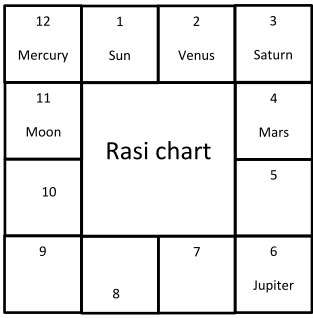
Let me first introduce you to the framework of a horoscope. The following picture shows a typical Tamil horoscope (also known as Jathagam). The building blocks of such a horoscope are the twelve boxes, popularly known as houses.

Typical horoscope showing the position of major planets

Before explaining the significance of twelve, let us first look into one of the most profound mathematical concept; 360 degrees. Many things that happen around us can be explained using 360 degrees. For example, earth completes 360 degrees when it revolves around itself once. It completes 360 degrees when it completes one full rotation (orbit) around the sun. Similar to Earth, other planets also complete 360 degrees for one full revolution about itself or one full orbit around the sun. Moon completes 360 degrees to orbit around the earth.

How can we perceive this 360 degrees movement of various astronomical bodies based on observations from a naked eye? There are several ways to do it. One simple way is to divide 360 degrees into 360 1-degree sectors and keep track of the planets when the move from one sector to another. However, certain planets such as Jupiter are farther away from the sun that it is extremely difficult to keep track of their 1-degree movement using naked eye.

We need to divide 360 into larger sectors to make the objects traceable. How large? Let us say, 4 sectors of 90 degrees each? The problem with such a fewer number of segments is that it becomes impossible to track the faster movement of planets that are closer to the sun, such as Mercury. So just like one would conduct a grid independence study, based on the experience people have found that having 12 sectors of 30 degrees each will make this problem tractable. But, on what rational basis did they arrive at twelve?

A long time ago, when there were no telescopes and technological gadgets around, people relied on naked eye observations. With no city lights to pollute, clear sky nights were absolutely dark that they were able to see far more stellar objects that are possible to see today only with the help of powerful telescopes.

One disadvantage of such a dark and starry sky is that it is extremely difficult to keep track of the movement of one particular object over a period of time. Solution? They started looking at the star's background to find its relative position with respect to other stars in its vicinity. In order to remember the position of various stars in the surrounding of the planet under observation, they identified some of the bright stars which do not move (on a relative scale) with respect to the planet. To make the problem easier, they grouped some of those bright stars to form a shape that is easy to remember. In other words, they formed a constellation.

They identified twelve major constellations with the help of twenty seven brightest and easily recognizable stars. The twelve constellations were roughly 30 degrees apart. So the problem of tracing a planet is now reduced to identifying in what background (constellation) does the planet lies at a specified time.

We would love to give names to anything right? Of course, we give names not only to the newborn but also to pets and things around. So it's not a wonder that people named those constellations (houses) based on their patterns such as Aries (Mesha), Taurus (Vrishabha) etc.

Now, all that one needs to do is to find in which house (constellation) does each of the observable planets reside at the time of their birth. In the typical example shown in the picture above, one can see that when viewed from the Earth (that's the reason why you won't find Earth in any of the houses), Mercury would set before sun while Venus sets right after sunset, followed by the Moon. When the sun and moon are in the same house, it is no moon day (or Amavasya) and when the sun and the moon are 180 degrees apart (or 6 houses apart), it is full moon day (or Purnima).

In terms of time, Earth takes 24 hours to complete one full revolution around itself (360 degrees). In other words, it takes 2 hours to rotate by 30 degrees. Since sunrise and sunset is defined with respect to Earth's rotation, the setting time of Mercury (Venus) would not be more than 2 hours before (after) sunset. However, using the same chart, it is possible to fix our frame of reference for time on some other planet as well.

For example, Jupiter takes 11.86 Earth years (4332 Earth days) to complete one orbit around the Sun (360 degrees). Hence, in order that Jupiter moves its position from one house to another (Transit of Jupiter), it will take 361 days (~ 1 Earth year).

Now the main question still remains. Does the location of planets in an arbitrary background at the time of one's birth have any significance in predicting their future? I will leave it up to the readers to find an answer to this question!

Nov 1, 2012

Jam's Quotes

Note 1: I am sharing a collection of my quotes which originated either while I was having a conversation with my friend(s) or when I was contemplating on something (usually nothing :P). I had shared some of these quotes in my facebook timeline, while others are used in short stories that are published on my blog.

Note 2: If you find any of my quotes to be synonymous with some existing one, perhaps I rediscovered it!

In one life that we live, there are people who help us and later expects a favor in return. Some will help us because they are friends, while others help us because they are family/relatives. But there are few who comes in our life when we most wanted them to, help us in evolving into a better person, and leave without a trace when their job is done.

Routines of today become rituals tomorrow.

Using science to commercialize an idea is like praying to God to pass an exam.

Rituals come with an expiry date!

In my graduate days, I learned to make money. In my research days, I am learning to look beyond.

When I die, I'm going to find the person who first coined the word "sorry", slap him hard on his face and say "I'm sorry!".

Book sellers offer up to 40% off plus free shipping and still makes a profit. No wonder why poor people are illiterate!

Atheists are not against God. They are against stupidity. If people think God is stupidity, it's not an atheist's mistake.

When an art form takes you closer to God, it becomes a classic.

The difference between past and present legend is the past is forgotten, the present will be forgotten.

What we solve as class room problems today had given so many sleepless nights to several researchers not so long ago!

People who take success close to their heart takes failures closer.

I don't know if God exists or not. But what I do know is nobody is God.

We live in a society where elites working for poor are labeled as social, kind-hearted and humane, but not as duty-minded.

The purpose of religion is to give hope to every single individual on this planet. So long as it serves the purpose, I believe in God, even if science disproves his/her/whatever's existence.

In the 25th century, a guy will get "creative design" award for his design of a fashion wear. The dress will be made from single piece of cloth and is complicated to wear. Still, it is going to revolutionize the clothing industry that every woman on this planet would like to own the masterpiece. The artistic design can be worn on any seasons/occasions. Only time knows that centuries back, people called the design wear as "saree"!

The universe keeps expanding forever, and so does the space between people in their hearts. Unless a star of activity takes place in their heart that can pull things down by gravity.

A picture is worth a thousand words. But a good writer can make you visualize the picture with his words!

Most people look at the dots and not at the theory that connects them.

No country. no nation. no boundaries. no dispute. no language. no technology. no science. no religion... hey nature! it's going to be just you...and me.

A teacher continues to teach even if he/she does not get a good student, for it is their job. However, it's not money but a good student, who adds value to their lives.

"A boy or a girl?" is the question that comes to anyone's mind when we hear someone is conceived. Does the life in the womb know any gender? An equal society is not when men and women are treated as equal, but beyond.

Never give free advice, for people will never listen. Charge them a consultancy fee and they will be all ears.

You know you had a great day if you are able to read at least 50 pages before you sleep.

Some people are not open-minded because they do not know how to open their minds. It's not their mistake though!

Jun 16, 2011

Weird wired connections

When my sister-in-law was preparing coffee for me, she was also boiling water in a pot to prepare kanji, a nutritional mixture, for her two year old daughter. I was playing with Snigdha meanwhile to keep her engaged so that she does not disturb her mother while preparing her food.

Sniffing the aroma of kanji through the air, Snigdha understood what her mother is preparing. When I picked up my cup of coffee, she ran towards her room, lied down in the cot pretending to be asleep. I could not figure out what was happening!

What happened da? I asked her.

"Thachi", said she, in her sweet mazhalai voice. A cute innocent smile was spreading over her face.

"Is she all right? She is feeling sleepy all of a sudden!", I went to the kitchen to ask my sis-in-law.

"This is her usual tactics to avoid drinking kanji", she explained to me. "I do not know how to feed this girl! She keeps avoiding all nutritious food. But her immunity is too low. She catches cold/fever in a blink, or chew something that she picks from floor in her mouth causing diarrhea", she whined in a concerned tone.

Well, its not her fault after all. Unfortunately, the tasty food are generally not good for health, and the converse is also true! She just happen to be yet another victim for taste, I was thinking aloud to myself. But what concerned me the most is her tactics to keep her mom from feeding her the kanji.

The aroma in the air quickly alarmed her about what is coming next, and she quickly devised a plan to avoid it. And all this was happening in an infant's brain! I took a sip from my cup of coffee while wondering about the mysterious weird wired connection of a two year old kid!

Jun 16, 2010

How to define success?

A person finishes his engineering from some xyz college of engineering which is affiliated to one of the best universities in India. He then went on to apply for a software job through campus interview, got selected and have been offered posting in IT hub at bangalore. After few months of training, he was offered to go abroad (typically to US) for a period of few years to work on client’s side, allowing him to earn in dollars. After completing his tenure abroad, he comes back to India with a “US return” tag which enables him to automatically get a priority while looking for a suitable match. Fortunately, his horoscope matches with one of the beautiful girl in his community.

He marries the beautiful girl, takes her abroad for honeymoon either to Europe or US, buy a car, a home, spends his weekend trip with his wife on trekking and other activities, organizes party every week with his “close” friends, becomes father, read books to his kid and bring him up in rich atmosphere, provide him/her the education from one of the best (also the richest) school in India, and on and on and on.

There is this another person, who manages to finish his under graduation from abc college of engineering, not happy with what he had learnt, went on to pursue masters, still not convinced he has done anything, went on to struggle himself day and night, spent lots of sleepless nights arguing with his peers and colleagues, make a small but significant leap which enables him to get a Ph.D, still not satisfied, takes up a teaching post in a research based institute, does research with help from his grad students, spends lot of times with his students than with his family (if at all he gets one), make a startling discovery of something which nobody in this world is interested on. In pursuit of his dreams, he realizes that he doesn’ t have time to socialize with his friends, can’t afford to spend time with a girl in cafeteria unless she is his colleague and talks about research but not sex, felt bad because he couldn’t get priority in looking for a suitable match, even worse when he was told that beautiful girl’s horoscope does not match with his own, can’t stand questions from his relatives/friends who keeps asking him “what you do for your living?” and on and on and on.

Who among the two persons you see here has a successful life?

Inspired from Peer cruelty.

Feb 6, 2010

Understanding Nature

They divided themselves into three groups: First group collected the facts. Second group came up with theory to explain the facts. Third group contemplated to come up with new technology based on the facts and theories. They then pass it on to their offsprings.

Their offsprings divided themselves into three groups: First group used new technology to observed new facts. Second group debated old theories, found their ancestor's theories are either wrong or incomplete and put forward new theories. Third group contemplated in advancing the technology with new facts and theories. They then pass it on to their offsprings.

Their offsprings again divided themselves into three groups: The three groups did more or less same as their ancestors, but with newer technology, newer facts, newer insights and theory, more disagreement with previous theories.

It thus went on and on, offsprings to offsprings, generations to generations. They still collect new facts, debate on old theories, put forward new theory and advance in technology. All this, till they completely understand nature. Will they ever understand the nature completely?

Feb 3, 2010

317

317.

Let's list the above number in ascending order by taking one digit, two digits, and three digits at a time, respectively.

One digit numbers: 1,3,7

Two digit numbers  : 13,17,31,37,71,73

Three digit numbers: 137,173,317,371,713,731.

Now here comes the beauty. Numbers that are less than 317 (including 317) are prime (the number 1 is considered to be prime here in this context)! Numbers greater than 317 are composite! But what is so special about the number 317?

That's my hostel room number :P.

Like this post? Please subscribe to RSS feed to receive all updates!