Showing posts with label review. Show all posts

May 21, 2015

A Review of Shattered Dreams (Book II: Ramayana - The Game of Life)


Shattered Dreams is a sequel to the first book in Ramayana - The Game of Life written by Shubha Vilas, a spiritual seeker and a motivational speaker. Honestly, I have not read the first book titled Rise of Sun Prince, which was based on first chapter or Bal Kanda of Ramayana. But then, a book based on one of the most popular epics is like packing old wine in a new bottle. What really matters is the way it is presented.

Unlike works of fiction, epics like Ramayana does not revolve around a central theme; rather myriads of sub plots are involved. The sub plots themselves are so subtle that it requires a qualified scholar to interpret and tell the story, while retaining its original meaning intact. However, new authors/publishers are more interested in popularizing epics, just like scientific findings reached the common man through popular science series. The advantage is that it makes many young readers "read" the work. The flip side is that only the essence can be captured through such "fast read" works.

Through The Game of Life series, the author has made an attempt to rewrite Ramayana in a "readable" way targeting young Indians. I must say that the author has done a commendable job in achieving this. The book is surely a page turner, so fast that one does not realize that he/she is reading from a classic epic story. This itself is a great achievement in my opinion, as the original work was written ages ago in a language which now barely a few speaks.

In order to add more spice to the story which many of us have already read or heard through different sources, the author has written anecdotes at every page. Though adding spice would excite more taste buds, a food which is entirely made of spice can never be had. As the saying goes, “too much of anything is good for nothing”. While some of the anecdotes were interesting to read, most of them are philosophical.

In a work of fiction, it is not common for a reader to say that I had to read a particular paragraph twice to understand what the author is saying. In my case, I had to read several anecdotes twice to understand what the author is saying! The flow gets affected due to this and that makes the “readable” book non readable. But then, what makes these anecdotes irksome is their presence in almost every page. It sometimes made me wonder if I am reading two books at the same time, instead of one! My suggestion to new readers; ignore the anecdotes and read the story first. After you are done with reading, go through the anecdotes.

We live in an era at which our youngsters do not have time to read classic epics nor to hear them from their granny’s. A few decades ago, Rajagopalachari (popularly known as Rajaji) wrote a simple and yet concise version of Ramayana. Shubha Vilas has reproduced a similar version, but this time catering to the masses.
 
This review is a part of the biggest Book Review Program for Indian Bloggers. Participate now to get free books!

PS: I should have written this review ages ago! However, I could not find time to sit and compile my views due to prior work commitments. I sincerely appreciate blogadda's patience and tender my apologies for such a prolonged delay.

Dec 5, 2014

Review of The Mahabharata Quest

"Christopher C Doyle”, I read the author’s name aloud holding the book I have just received. Has blogadda asked me to review the work of an American author?", I wondered. After googling, I came to know that the author is very much Indian who went to St. Stephens and IIM Calcutta for his education.

I have never heard about the author, was my first reaction; he had already published a book before titled "The Mahabharata Secret". Could "The Mahabharata Quest" be a sequel to his previous work then, a doubt surfaced from my mind? I hoped that it is not so, for otherwise I would have to read his first book in order to be able to review the second one.

I felt relieved when I felt that I was able to follow the story after reading first few chapters. So I decided to continue with it. I have read contemporary fiction before; I have read historical fiction before. The first few chapters made me realize that here I am reading a work which is a blend of contemporary and historical fiction.

The challenge is to come up with a compelling contemporary actions that connect the story with the past. Doyle has done a very good job at this. He indeed transported me into a fascinating world where ancient secrets buried in legends blended with science and history to create a gripping story.

Three forth of the book is surely a page turner. I finished reading this part within a few hours of single sitting. However, the story moves with a different tempo after the protagonist help the Order find the way to the secret location, following the footprints of Alexander the great.

Doyle’s scientific interpretation of Koorma avatar, a legendary story told in Mahabharata and in other texts, is not convincing. In order to convince the reader, he continued to explain more scientific terms in the latter part of the book. I felt as if I am reading a science book rather than a work of fiction.

While “The Mahabharata Quest” is not a sequel to “The Mahabharata Secret”, certain characters are common in the two stories. After the discovery of the ancient site, the author keep mentioning about the protagonist’s first expedition to discover the secret scientific events told in Mahabharat. It will be better for the reader to read the author’s first book before reading this one, for then the reader will know well about the events that the protagonist is talking about.

Finally, the author’s writing style deserves an applause. As I mentioned earlier, the author has done a very good job of blending science with contemporary and historical fiction. He does this by changing the story flow alternating between present and the past, while maintaining the story flow smooth and easy for the readers to follow.

To summarize, “The Mahabharata Quest” is an excellent piece of fiction writing by Christopher C Doyle. With his magic spell of writing, the author ably transports a reader to the past, rediscovering scientific events that is hidden in legendary stories. It is a must read book for everyone. I rate this book with 4.5 stars out of 5.

This review is a part of the biggest Book Review Program for Indian Bloggers. Participate now to get free books!

Sep 3, 2014

Review of Private India

Spoiler Alert: This review contains spoilers.
----------------------------------------------------------
"Will I be able to read 470 pages work of fiction and write a 500+ words review article within 7 days?" I questioned myself reflecting on a daunting task that I've committed to blogadda. When the neatly wrapped book finally arrived at my hand, I could not wait for a moment to start reading. As expected, the authors, Ashwin Sanghi and James Patterson, did not disappoint me with their affluent writing style which made the book another page-turner. In fact, I would have finished reading the book in one-night, had there not been frequent power outage in my area.

If you are looking to read a book in a weekend or keep yourself engaged while traveling, buy a copy of Private India. "Is it that good?", you may ask. From reading point of view, yes, it is very good work. Coming to plot, the authors had tried to build suspense and thriller by introducing lots of knots, some of which are not tied in the end.

From my experience, I found that if the start is impressive, overall impression about the story will be good. It is easy for the author to keep up with the momentum once he gets a good start. In Private India, the first chapter was written so nicely that I re-read it several times. It has everything in it; a gentle start, smooth flow, a surprise murder and finally the innocence of the housekeeping in her next thought after spotting the body.

The flow through the subsequent chapters show that the authors indeed had kept up with the momentum they gained from the first chapter. Even though I have not read James Patterson's work on Private before, it is well introduced in the plot. But the authors failed to carry forward the momentum by sticking to that old cliche; police officials are dumb and private detectives are super intelligent.

Ashwin Sanghi's style could be seen when the protagonist figured out that the serial killing has a pattern similar to nine forms of Durga. But the protagonist's conclusion that the serial killer is about to wipe off entire womanhood by killing nine women who had ruined the killer's past is nothing but a hyperbole. Even more, the reason given at the end for killing some of those women is not convincing. During the conversation between the serial killer and final women to be killed, the serial killer was accounting for all the killings; Priyanka Talati, one of the women who got murdered, was murdered because she found the secret about the serial killer when they both were in Thailand. Why din't the killer kill Priyanka in Thailand itself? Why did she leave her alive with a risk of secret being spilled any moment?

Towards the end, the authors failed to tie the knots tight. I do not understand the link between Indian Mujahideen and the main plot. If the authors tried the Mujahideen angle to show even greater danger Private India is facing, my opinion is that they could have done it in a better way.

To summarize, we have read/watched umpteen novels/movies involving serial killer. How about a female serial killer then? But then, are females both physically and mentally strong enough to carry series of murders without getting caught? How about having a female serial killer who is gender reassigned to become a male? It is this idea that forms the crux of the story.
This review is a part of the biggest Book Review Program for Indian Bloggers. Participate now to get free books!

Dec 30, 2012

Moonlight Becomes You


No one can predict what will happen the next moment. Nature's way is to surprise us by not revealing us about the future. Our efforts in understanding nature and its ways had made us look into the past and recognize patterns that we believe contains the clue to what lies in ahead of us.

Often times, we chance upon those clues and call them as coincidences. But is it possible to counter a serious of coincidences in any one's life? A look into human history tells us that whenever such a serious of coincidences happen, there is always a human's hand in the course.

We always suspect that something is wrong when a few people who are close to each other die one after another, that too, peacefully at night when they all fall asleep.

We have experienced such events happen in our life. But how often do we begin to suspect and try to look at it from a rational perspective? 

How often do we have a quest to look into the pattern and try to connect the dots? How often do we isolate natural events from the events which are triggered by humans by virtue of their emotions; jealousy, ego, anger, frustration or whatever?

In Moonlight Becomes You, Mary Higgins Clark, through the eyes of Maggie (the protagonist), teaches us to identify patterns, isolate human element and trace the real culprit. If you are smart, you can find the culprit much before the climax.

A good writer is the one who introduces more than one pattern interlaced with another thereby confusing the reader. This is the best strategy that would result in having more than one suspect, which helps in building the suspense element in a novel. After reading Moonlight Becomes You (my first book of Mary Higgins Clark), I have no doubt that she is a good writer.

Dec 23, 2012

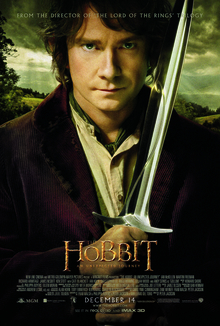
The Hobbit - An Unexpected Journey

image courtesy: wikimedia

What makes a epic-fantasy-adventurous film a success?

The story should have some reference to epic character. There should be some adventure in the plot, such as searching for a hidden or lost place. And finally, there should be some fantasy in the story.

The first part in prequel trilogy has all the three. A group of dwarfs with a king were on an adventurous trip to the Lost Mountain, a place in the middle Earth which was home to dwarfs until the dragon took in possession of it. There is enough epic story to delight from, fantasy to relish and adventure that will hold you on your seat till the end.

Lord of the Rings, a sequel to The Hobbit, starts with Bilbo Baggins giving the one ring to Frodo Baggins voluntarily, the first character to do so. In The Hobbit - an unexpected journey, we find how the ring ended up to Bilbo Baggins from Gollum, an important character in LOTR trilogy. One of the recurring characters is the wizard Gandalf who saves the dwarfs from various difficulties they face during their adventurous search of the Lost Mountain.

Watch it if you haven't so far, but do watch the movie in 3D if it is screened in a nearby theatre to enjoy the eye-pleasing visuals the movie offers.

Dec 19, 2012

Review of The Sins of The Father


The Sins of the Father is the second in the Clifton Chronicles series by Jeffrey Archer. When I first found the book in flipkart, I placed the order to buy without any hesitation. However, I had to leave India in a short notice that I could not finish reading it before I left. When I found the book at the Fort Collins Public Library, my joy knew no bounds! It was only natural for me to jump at it and checked out immediately.
Will Harry get acquitted or escape from The US of A by proving his real identity or other means? Will he be able to prove that he is indeed Arthur's son and reunite with Emma? Will Maisie's dream of living a respectable life come true?
These were some of the questions Jeffrey raised towards the end of Only Time Will Tell. While education was at the center of first part, the second part was pivoted around legal issues. After all, everyone wanted to know if Harry could marry Emma!

Jeffrey's personal and political experiences in legal issues had proved to come in handy for him to untangle the knots he made earlier. Harry's first experience with a crooked, nevertheless reputed lawyer had only helped in landing in jail. But it was only for Harry's good, for he had plenty of time to spend, and  spend he did, writing his biography in the form of a diary, which soon proved to be a hit in New York bestseller list.

Meanwhile, Emma had an intuitive feeling that Harry could not have been buried in sea, took painstaking effort in crossing the Atlantic as a crew member of the same ship Harry believed to have taken, searched by all means to locate Harry and get him acquitted. By the time she got closer to her objective, Harry left the prison in exchange for commanding an American troop against the Germans in Second World War.

Harry did unite with Emma and his son Sebastian in the end. But the legal battle whether Harry could marry Emma still continues. In fact, the issue is no longer a personal battle for the Clifton and Barrington families, but had become one of the political issue which could affect the fate of elections soon to be held.

Neither Cliftons nor Barringtons could help solve Harry and Emma the mystery anymore, for now it now depends on the outcome of the voting at House of Lords. Should the Law Lords vote for Harry to be Sir Harry Barrington, Harry can never unite with Emma.

The voting had a dramatic finish with the House divided with 273 votes for and against Harry. The decisive vote by the Lord Chancellor would settle the issue. But for that to happen, we should all wait for Jeffrey to finish writing the third and final part of the Clifton Chronicles.

Dec 9, 2012

Taken 2 - a review


Watching Skyfall and Taken 2 back to back in that order is certainly not a good idea for James Bond fans. Taken 2 easily qualifies to be a James Bond level movie, for it has a smart hero with good physique, use innovative technologies and devise creative strategies to deceive the villain. Perhaps the only things that are missing from Taken 2 to be called a James Bond movie are the most popular dialogue "My name is Bond" and the theme music.

Does it mean that Taken 2 is a good movie? In my opinion, its a better movie than the recently released Bond movie, Skyfall. But I won't rate Taken 2 as a good movie, for there are some scenes which are quite similar to other movies as well. When the hero and his wife were blindfolded and taken by the father of a villain from Taken, he measures the ticks on his clock, senses the maneuvers, listens to sounds from outside world to find where they were taken to. Fans of Rajnikanth can easily identify this particular scene with one of his movies in which he was taken by a villain's gang blindfold, and he smartly traces back his path to reach the villain's place using the observations he made while he was taken.

There are scenes from Taken 2 which doesn't make sense to me. When the girl comes out of the room from hiding, the security guards were not alarmed. And then, she goes on dropping bombs at different locations to find how close she is to her father, all without alarming the villains or the police, and, well, not even the crowd!

Barring such mistakes which are common to most of the movies in this genre, Taken 2 is a movie which can be watched once.

Dec 3, 2012

Life of Pi and Kurma Avatar


"Amazing! Brilliant! Extraordinary! Wonderful!". I could add more adjectives to praise the recently launched movie "Life of Pi". But I'm going to write about something different than the movie itself, something which the movie reminded me of while watching it. The story of Kurma Avatar.

There are two versions of the story of Pi as narrated by Pi himself to a local novelist; rational and irrational. In the irrational version, Pi tells that he shared a lifeboat along with a zebra, an orangutan, a hyena and a royal Bengal tiger after the ship in which he traveled with his family sunk when encountered with a thunderstorm. Much of the film is based on this version with eye-pleasing visuals. Towards the end, Pi tells the novelist that he told another version of the same story to the insurance agents since they felt the story was irrational and unbelievable.

In the rational version, Pi tells the insurance agents that he shared the lifeboat with a sailor (a Buddhist who met Pi at the canteen - zebra), his mother (who had lost her first son, Pi's older brother - orangutan) and the cook (an arrogant person who mocked at Pi's parents while serving vegetarian food on board - hyena). Pi portrayed himself as the Tiger in the irrational version.

Wondering what is the connection between "Life of Pi" and the story of "Kurma avatar"?

Both stories have two versions; rational and irrational. I had written the rational version of the story of Kurma avatar on my blog. But it is the irrational version which is more popular and is considered to be with God.

Nov 4, 2012

Review: Girl With a Pearl Earring


Girl With a Pearl Earring
Girl With a Pearl Earring by Tracy Chevalier

My rating: 4 of 5 stars


"Only a diamond cuts another diamond, so says a proverb. Could this be said of arts too?" was the first thought that flashed my mind when I saw the title "Girl with a pearl earring" from the fiction rack at Poudre River Public Library.

I do not often venture into a new reading from an author whose work I had never read or heard before. But my insatiable quest that was lingering in my mind made me decide to borrow the book.

Even before I started to read the first page from the book, a chain of thoughts about who could the girl be flew through my head. From the abstract of the book I imagined the girl to be a princess from a rich kingdom. "Is pearl a symbol of richness?", I questioned my own thoughts. A princess could have worn a gold or diamond earring!

A look at the front cover which has a portrait of the girl with a pearl earring said she could not be a princess, but an ordinary girl just like the ones we come across daily at any place. Only that she looked different in the eyes of an artist who had decided to paint her.

The novel is a blend of fiction with real facts; artist Vermeer is real and so is the painting Girl with a pearl earring by him. The story is about a girl who became a maid owing to family circumstances and how she became the source of inspiration for the artist, or so I thought until I read through near end of the book. Though the complete story is narrated from the maid's perspective, it is a story of an artist who is caught between love of his profession and family's responsibility and his struggles in balancing the two.

I am not sure if I would read more of Tracy Chevalier's works, but the "Girl with a Pearl Earring" is a book which I would not hesitate to recommend.


Oct 28, 2012

Review: The Way Of The Bow


The Way Of The Bow
The Way Of The Bow by Paulo Coelho

My rating: 5 of 5 stars


The way of the bow is a story of an archer who had mastered not only archery, but how to use the skills he had learned to live at peace. The story begins with a stranger asking for a man named Tetsuya at a boy who probably lived in the neighborhood. The boy was startled when the stranger asked for Tetsuya, the most famous archer. All these years the boy and the neighborhood knew Tetsuya only as a carpenter.

When the stranger finally met Tetsuya, he challenged Tetsuya to prove that he had perfected the art of archery and so he be announced as the best archer in the world. Tetsuya observed the stranger's posture, the way he held the bow, drew the arrow, set an eye on his target and the way he released the arrow towards the target. He immediately understood that the stranger had perfected the art, but failed to control his mind. In order to prove his point, Tetsuya took the stranger to a broken wooden bridge in a mountain, went to the middle of the bridge, balanced himself, took his bow and with a borrowed arrow shot at a target he had set at 20 meters distance. He then asked the stranger to repeat what he did in order to be accepted as the world's best archer.

Failing to do so, the stranger accepted his failure, bowed in front of him and left with the promise that he would never reveal the identity of Tetsuya to anyone. On the way back home, the boy led with his curiosity, asked Tetsuya to teach him the real art of archery.

Tetsuya taught the boy about the bow, the arrow, the target, the posture and finally the flight of the arrow in a philosophical way. The teaching ended when both the boy and Tetsuya reached the carpentry workshop. When Tetsuya bid a goodbye to the boy, the boy asked him to share his own story.

Long ago, when Tetsuya was working for a great nobleman, he spent most of his time with booze and girls to the extent that he fell down one day and was almost dying. An archer saw Tetsuya in an unconscious state, took him to his place and medicated him. Upon recovery, Tetsuya asked his saviour to teach him archery as he had found the art to be meaningful than whatever he had done in his life so far. After teaching archery to Tetsuya,the man took his arrows leaving the bow as a souvenir and asked him to leave and do what he loved to do. Tatsuya realized that he loved carpentry and that's how he ended up starting a carpentry workshop.

After reading the book, every reader would find himself at peace, draw inspiration from the story to love what he/she does and strive to evolve into a better archer. For archery, as Paulo Coelho writes, is not just about leaving the arrow from its bow with precision, but with soul.

The Way of the Bow is available for free download from here.

Aug 17, 2011

Review of I have a Dream

John Kennedy, in one of his famous speeches, said "...ask not what your country can do for you, (instead) ask what you can do for your country". This quote is not only inspirational, but also explains the difference between a monarchy and a democratic form of Government.

In a democratic country, Government is constituted both by the people and their elected representatives. In other words, the general public is but a part of the Government. So, it is a collective responsibility for the public to work hand-on-hand with the elected representatives for the country to  develop and prosper.

In I have a Dream, Rashmi Bansal had personally interviewed twenty idealists, also called as social entrepreneurs, who believe in democracy, contributes their time and skills for the betterment of their fellow men, and had presented their experiences in the form of twenty short stories.

Though many of us have the feeling that we should contribute our part to our society towards development, most of the times we restrict our contribution towards paying our taxes, or writing a letter to concerned authorities and waiting for them to take an action. At the most, we pay a visit to the local municipal/corporation/panchayat office to remind the concerned authorities about our plea. But there it ends!

When the concerned authorities do not take an action (for whatever reason), we keep ranting about it and learn to adjust ourselves to live with difficulties. We wait till the next election, elect new representatives only to start the vicious cycle all over again! The problem can be as easy as installing street lights, or construction of a public toilet, building new class rooms or improving infrastructure of the school/college laboratories.

So what do we do here? Should we just keep ranting and accept the difficulty as part of our life? Should we just sit quite and curse the authorities/government till next election dates are announced? Or is there something which we can do ourselves for the betterment of our lives? Were the elected representatives finding it difficult to execute each and every plans on their own? If such is the case, can it be changed by lending a hand for a social cause?

Twenty idealists have asked this question, at various stages, at different times in their lives, and in different difficult situations. And they all got one answer in common! That in democracy, it is our responsibility as a general public to work hand in hand with the elected officials in order to make progress and move our country towards development.

But how do we help the government? Where to begin? After all, we are not philanthropists to render help without thinking about "what do I get in return". Most of us, who have a social calling, belong to the salaried middle class, where there is a necessity to earn our livings. Is there a way to couple our earnings with an added social value? Yes, says Rashmi Bansal in twenty different voices. In fact, the concept of coupling our earnings with an added social value lies at the heart of what is called as social enterprises.

I have a dream explains this concept in twenty different voices. If you have a social calling in you, feel that it is your duty to lay a helping hand with the elected representatives, want to have a different perspective of the enterprisal word "profit", but do not know where to begin or how to execute, this book is the best place to start with.

This review is a part of the Book Reviews Program at BlogAdda.com. Participate now to get free books! 

Jun 17, 2011

Review of A Thousand Splendid Suns

"Suggest me a book to read", I asked my friend.

"A thousand splendid suns", came the reply in a blink! "But, its not for a light reading", he warned me after. I googled for the title, went through the reviews, opened flipkart and placed an order in an impulse. After receiving the book a couple of days later, I placed it in my shelf amidst a number of books in "to read" shelf, and I totally forgot about it.

The reason why I hesitated to read this book has to do with the way I chose the books to buy/read. Instead of selecting a book based on the reviews or the story, I select them based on the authors whose writing I like. Though I had watched Kite Runner from the same author, I had not read any of his work yet!

It was in a spur of the moment my curiosity sparked and drove me to the first page. The opening line of the book added fuel to my curiosity and then I felt myself saying, "I think I like this book!"

I soon realized that a thousand splendid suns is indeed not for a light reading, and so I paid more attention in reading it whenever I got some time to spare. Caught on with the positive feedback as I flipped through the pages, I finally finished reading this book in a week since I started.

No, its not the story that I was obsessed with. Nor the writing style of the author. I could not believe for a second that I am reading a story! While reading, I found myself transported to Afghanistan, and as a mute spectator, I felt as if I was living with the characters and observing them from up close.

I felt like I played with Mariam during her childhood days, comforted her when her father deserted her, mourned with her when her mother hanged herself, pitied her when she was married off to an elderly widower, was concerned about Laila when she joined her, agitated when she tried to escape along with Laila from the clutches of Rasheed, tempered when Rasheed treated her badly, and finally felt peace when Mariam gave a blow on Rasheed's face with a shovel.

None of the books that I had  read so far had made me to feel connected with a character this way!

Apr 26, 2011

Review of Rio (film)

3D movies are becoming popular nowadays that people are coming to theater to watch 3D effects  without bothering much for the story. Animated 3D movies are much popular because of its ability to attract people of all ages. Rio is an animated 3D film, without a strong story line.
My scholar friend (who works in same laboratory as mine) and I went to Satyam theater to watch Rio, for its 3D effects. It is his first, and my second movie to watch with the extra dimension (my first one was Avatar).

A blu(e) macaw, supposedly the last male from its species, was captured from Rio, found by a girl while on transition to Minnesota. After fifteen years, a scientist finds Blu in a local book store living with the girl who rescued it, tells her that he has the last female macaw which has to mate with this last male, to preserve the species from becoming extinct.

The plot expands when Blu was captured by the smugglers in Rio, trying to sell both the macaw for money. How the macaws manage to escape from the smugglers forms the rest of the plot. The film becomes grippy with its 3D effects during the escape sequence. The carnival in Rio adds more color to the plot and also make the escape dramatic.

Rio is worth a watch just to experience the third dimension effect.

Review of Geek Nation by Angela Saini

There are many books written on our (Indian) ancient wisdom. And then, there are many books written on science. But Geek Nation is "one of its kind", in that, the author, Angela Saini, has tried to connect the two, in order to find how Indian science is taking over the world, by looking at its past as well as into its future.

The answer does not seem to have come so easily, for the author had to travel across the length and the breadth of our country, and meet various people to get their views. The experience she got from her journey across the country, and her interaction with prominent scientists and technologists, whom Angela identifies as the "Geeks" of India, forms the crux of the book.

The title of the book is so catchy that I placed an order online through flipkart immediately after I first saw it in the new releases list. The ability of the author to explain a complex scientific stuff in plain english, which can be understood even by people who do not major in science, is one of the reasons why I like the book.

How does the geeks of India passing down the technologies to solve the common man's problems? Does our ancient wisdom helps our geeks to find a solution to most of these problems, as (many) people claims? What is our geek's take on pseudo-science such as Astrology? To find answers to these questions, and many more, one has to read "Geek Nation".

Apr 19, 2011

Review of Only Time Will Tell by Jeffrey Archer

The profoundity in the elegant statement "Only time (or whatever that may be) will tell" made by Stephan Hawking in his book "A brief history of time" captivated my thoughts so much that when Jeffrey Archer wrote his book titled "Only time will tell", I pre-ordered my copy two weeks before its release date on landmark.

This said, the reader should not come to a conclusion that I have no idea of Jeffrey's writing, or I am no fan of his works. In fact, I have read two of his short story collections of which "Old love" and "The Hungarian Professor" are my favorites. His short stories inspired me later on to write one myself, while many newbies generally start with a novel!

"Only time will tell" is the story of a young man Harry Clifton, whose life began in the backstreets of Bristol. I have never heard/read of a poor/poverty stricken people living in one of the most advanced nations. So when I read about poor Arthur, Maisie and uncle Stan, I was surprised at first.

As the author narrates the story, I realized that poor man is a poor man anywhere in the world. But Maisie, mother of Harry, decides to change their fate by sending him to the best possible school, and later on to Oxford with all the scholarship he could get, and with her sacrifices when he couldn't get any.

That education plays a crucial role in raising one's class of living has been narrated in a way only Jeffrey can, with all the dramatic stumbling blocks and the way Harry overcame every one of them. But there is only one set back that Harry can never overcome. His love.

Earlier, Maisie confides into Old Jack (Harry's mentor) that Arthur may not be Harry's father, as she had sex with Hugo Barrington a week before their marriage. This makes Hugo's  daughter Emma, Harry's step sister. But Harry and Emma did not know about this, and were deeply in love with each other. The secret was revealed to everyone by Old Jack only when they both were about to get married in a church.

In order to find a solution to the complicated relationship, and also to serve His Majesty, The King, Harry ventures into voyaging, with help from Sir Walter Barrington (father of Hugo) as his grandson. But as soon as he lands in America with a fake identity, he was arrested by the immigration officials for a first degree murder.

Will Harry get acquitted or escape from The US of A by proving his real identity or other means? Will he be able to prove that he is indeed Arthur's son and reunite with Emma? Will Maisie's dream of living a respectable life come true? Only time will tell, for one has to wait till Jeffrey writes other volumes to know the answers to those questions.

Mar 19, 2011

Review of My Days

We often appreciate good works published by our favorite authors, Sidney Sheldon or R. K. Narayan. But how much do we know about these authors? What made them to choose writing as their profession? What or who is their source of inspiration? Where do they draw their characters from? How do they construct a plot? Are all fictional stories really fictitious? Is there a personal touch of a writer in his characters based on his/her real life experiences? In "My Days", R. K. Narayan has tried to answer some of these questions.

"My Days" an autobiographical work of R.K.Narayan, is worthy of his novels, says his friend Graham Greene. True to this, the book had been written with elegance, like any of his other works. Starting from his childhood days where he used to play with unusual pets of monkey and a peacock, he takes us with him to a journey which shows a peek of his life; the hurdles he faced at war times, personal and financial difficulties that loomed over him on several occasions, and how he faced those issues which never deterred him from writing.

My Days is certainly an inspirational work, especially for young and aspiring writers whose dream is to choose writing as their career.

Mar 10, 2011

Review of Chanakya's Chant

Little is known about Chanakya, the author of Arthashastra, who is supposed to have lived some 2300 years ago, believed to be the chief architect of Chandragupta Maurya's rise to power. The unknowns are vast that it leaves plenty of opportunity for historical fiction writers to fill in those gaps with their creative imagination. In Chankya's Chant, Ashwin Sanghi went one more step ahead.

While going through the mind of Chanakya to understand his strategic mind, a number of question arises. What was the political situation like during Chanakya's period? What made him to architect Chandragupta Maurya rise to power? Who were the enemies with whom he fought in order to achieve his goal? If he ever succeeded in his mission, why were his works not popular in today's world? Finally, what was his love life like? Did he fall in love? If so, how did he balanced his love life with politics?

The questions posed above to the reader is not complete, however, it gives you an idea of a good start for a story. In addition to these questions, Ashwin added: "What if Chanakya were to be cursed by his lover due to his greater love for the nation instead of her? If Chanakya were to be cursed, what is the cure for his fault?

Chanakya's Chant is as follows:
Adi Shakti, Namo Namah; Sarab Shakti, Namo Namah; Prithum Shakti, Namo Namah; Kundalini Mata Shakti; Mata Shakti, Namo Namah.
which means
Primal Shakti, I bow to thee; all-encompassing Shakti, I bow to thee; that through which God creates, I bow to thee; creative power of the Kundalini; mother of all, to thee I bow.
Chanakya indeed had a girl friend, named Suvasini. He was cursed by her since he paid more attention to the nation to the extent that he used Suvasini as a whore to achieve his goal. However, Suvasini felt sympathetic with Chanakya for his nobel cause, and hence suggested the following cure
Four thousand days you shall pray
Four hundred chants every day.
Chanakya's power is yours to take
Chandragupta, to make or break.
If there's a lull, start once more.
King must be queen, to be sure.
Suvasini's curse shall forever halt
If you can cure Chanakya's fault.
The chant forms the central theme of the story, the mantra japa gives the contemporary kingmaker Pandit Gangasagar Mishra the Chanakya's power for rising Chandini Gupta to queen (prime minister of Independent democratic India).

While Suvasini herself was chanting for Chanakya in order that he succeeds in his mission to Lord Shiva
Om tryambhakam yajamahe, sugandhim pushtivardhanam; urvarukamiva bandhanam, mrityor mukshiya maamrital.
which means
O praise to the Three-Eyed One, who increased prosperity, who has a sweet fragrance, who frees the world from all diseases and death! Liberate-as the fruit from the wine. Shiva, grant immortality!
Chanakya's Chant is an interesting read for all those who love to read historical fiction. Through his writing, Ashwin takes us back and forth to the Chanakya's time and present day with his vivid imagination.

Mar 5, 2011

Review of Bertrand Russell and Trinity

Its a story of the relationship between Bertrand Russell and Trinity college at one of the challenging times for humans in history, the World War I. The book was written by the an authorized person, a fellow of Trinity, G. H. Hardy who has access to most of the original sources, and is verified by Bertrand Russell himself.

The story begins with Hardy explaining about pacifist organizations (Union of Democratic Control, No Conscription Fellowship) and their role in conscription during the world war. It then proceeds in explaining why Trinity (council) took a stand to cancel the fellowship of one of the most famous and celebrated mind, Bertrand Russell. The last part is perhaps an unknown to many, even in Trinity itself, the reinstatement of Russell's fellowship and lecture post in post war era. The book is wonderfully written by G.H.Hardy, another celebrity mathematician of his times.

Dec 2, 2010

Review of Mynaa

Mynaa is a tamil film released during Diwali. But I get to know about the film only recently, and happen to see it as well. The first impression about the film is not so good, however, if you are a person who believes in "first impression is the best", you are in for a surprise! Because I loved this film as it progressed. I felt like I am reading a classic love story and not a movie!

The likable things from the movie are the location at which the film is set. The story revolves around a love story between a couple who lives in a backward village area amidst the beautiful hills. From the film, I found that the people don't have many basic facilities such as roads, electricity and water. The only way to reach this village is by a jeep which keep ferrying people from base of the hills until evening. The place looked like a forest area and as I guessed, there is a wild elephant chase scene in between.

The other thing that I liked is the philosophical line of thought, which can be summarized in one word: fate. The male protagonist happens to threaten the mother of Mynaa (obviously heroine of this film) because she wanted her to marry a rich guy from neighbouring village. One can't say she is against love; at the least, I would say she is trying to think practically. Having lost her life to a drunkard, she wanted her daughter to live happily by marrying her to a rich guy. This result in protagonist being sent to jail. He had to escape since he doesn't want Mynaa to be forcefully married while he is away. The escape happened during diwali, which is Thalai Diwali for the S.I (first diwali since marriage which is celebrated grand in in-law's house) who is longing to go to his in-law's house for celebration.

All is well if it ends well, so goes the sayings. The situation that happens in between which eased the tension between the police and the accused made one to think that Love eventually wins, however, the tragic ending twisted the story and that's the part I liked loved the most. In my opinion, Mynaa is one of the best movie from Tamil industry.

My ratings: 4/5